

Journalism Curriculum and Courses
Miami University Journalism majors must also complete a second major or a minor outside of the Department of Media, Journalism, and Film. Given that journalists must be well-versed in many disciplines, we encourage our majors to select a field of study that excites them and could possibly inform their journalism. Journalism majors complete 14 courses over four years, learning from a faculty with deep experience in the newsroom and the classroom. Your studies will culminate with a rich senior capstone experience that brings your learning together.
Below are a few of the courses offered:
- JRN 101 Journalism and American Life
- JRN 201 News Writing & Reporting I
- JRN 303 Multimedia Journalism
- JRN 340 Internship
- JRN 343 Sports Reporting and Writing
- JRN 412 Data Journalism
- JRN 421 Capstone in Journalism
Journalism, B.A. Learning Outcomes
- Recognize and develop news stories, keying on the so-called Five Ws (who, what, where, when, why and how), and to gather information that is factual, relevant, timely, thorough and valuable to a broad audience;
- Write news stories in the Inverted Pyramid style, crafting concise and compelling leads, constructing stories with facts ordered from most to least important, and incorporating transitional language between facts to provide a coherent whole;
- Identify and write news stories about issues that require deeper reporting and more nuanced writing, incorporating such narrative non-fiction techniques as anecdotes, scenes, descriptive passages and dialogue;
- Conduct quantitative research and analysis, and effectively incorporate the results of that work into stories about newsworthy topics of public importance
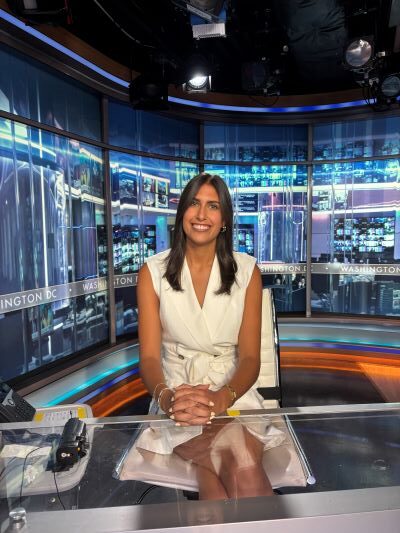
I knew from the beginning of high school that when I reached college, I would pursue a degree in Journalism. However, the Media, Journalism and Film department’s unique requirement of a second major, although intimidating at first, encouraged me to think beyond just my Journalism major. I landed on Political Science as my second major because after taking a U.S. government class my senior year of high school, I knew I wanted to focus my reporting skills on politics.
Career Options
Journalism graduates seek careers in many areas. Our students are well-prepared for any job requiring content creation for TV, radio, print or web. Graduates may become magazine editors, newspaper or TV reporters, freelance writers, copywriters or podcast hosts. Typically, about 10% pursue graduate degrees in fields such as journalism, creative writing, literature, technical writing, history or law. Grads of the last decade or so work in every facet of journalism in every part of the country – and even beyond: the Associated Press, Fox News, MSNBC, CNBC, National Public Radio, ABC, The Washington Post, Sierra magazine and The Chronicle of Higher Education to name a few, along with plenty at TV stations, radio stations and newspapers/sites across the state of Ohio. We keep close tabs on our grads – who are always ready and willing to visit classes, support our travel programs and provide key networking help to Miamians who follow behind them.
Lawyer
View Career DetailsGraphic Designer
View Career DetailsBroadcast Announcer and Radio Disc Jockey
View Career DetailsNews Analyst, Reporter, and Journalist
View Career DetailsPublic Relations Specialists
View Career DetailsTechnical Writer
View Career DetailsCopy Writer
View Career DetailsPrivate Detective, Investigator
View Career DetailsCopy Editor
View Career Details
Megan was managing editor of The Miami Student newspaper and worked as an advocate for students with disabilities. She interned at and now works for The Chronicle of Higher Education as a Reporting Fellow.
Additional Opportunities

Student Media Organizations
Student media organizations, like WMSR (student run radio station) and M.A.F.I.A (The Miami Association of Filmmakers and Independent Actors) is a student group that helps creative people at Miami get experience in film and Television production.

Inside Hollywood – Study Away Program
This highly popular Miami workshop in Los Angeles gives students who are passionate about media an intimate look at Hollywood careers.

Undergraduate Teaching Assistant Program
Highly selective, year-long undergraduate assistant programs give students unique opportunities to work on leadership teams with a professor and other highly motivated and skilled students. UAs develop real-world communication and professional skills as they serve as peer mentors and conversation leaders.
Facts and Stats
Your college experience here will be one of the most exciting times of your life. To make sure of this, we’ll provide you with a powerful support system.
-
90%
- First-to-second year retention Miami University Data
-
12th
- Among Public Universities in the United States for Four-Year Graduation Rate The Chronicle of Higher Education Almanac
-
No. 6
- Public university in the U.S. for long-term career success LinkedIn Best Colleges 2025
Related Programs
Miami students are an eclectic mix of thinkers, doers, leaders and followers, introverts and extroverts, authors, painters, climbers, coders, pianists, philanthropists, and gamers. Just to name a few.
Admission and Aid
Explore what it means to be a college student at Miami University in Oxford, Ohio, where students prepare to go anywhere and everywhere. We’ll be here to help every step of the way as you prepare for college admission, enrollment, and success.
Contact Us
Undergraduate Admission
Department of Media, Journalism, and Film
Joe Sampson
Journalism Program Area Coordinator and Lead Departmental Advisor
Williams Hall 110
Oxford, Ohio 45056